Key Facts:
- The Spike: 160,662 new cars registered in May 2026 (+7% YoY), with pure battery EVs up 34.2%—the best May since 2019.
- The Price Pressure: Petrol up 20% since the Iran conflict (159.43p/litre unleaded, 184.96p/litre diesel), accelerating EV consideration.
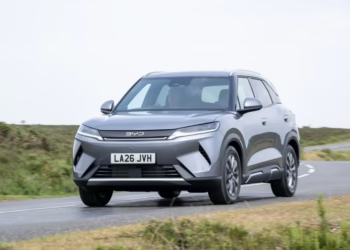
- The China Factor: Jaecoo 7 now third best-selling car of 2026; Chery to build vehicles at Nissan’s Sunderland plant.
- The Discount Drive: Manufacturers offering “substantial” incentives to move metal amid economic uncertainty.
Geopolitics Is Moving Metal Faster Than a Tesla Plaid Launch
If you’ve filled up in the UK lately, you’ve felt the sting. The Iran conflict under the Trump administration has sent oil prices—and pump prices—soaring, and British buyers are responding exactly how you’d expect: by looking at electric. The SMMT’s May 2026 figures show EV registrations jumping 34.2%, capturing 27.3% market share. It reminds me of the 2008 fuel crisis, when boxy SUVs suddenly looked less appealing and compact hybrids started flying off lots—except this time, the alternative is fully electr
ic and increasingly affordable.
Who’s Behind the Numbers
The Society of Motor Manufacturers and Traders (SMMT) credits expanding model choice, aggressive discounting, and “economic and geopolitical uncertainty” for the EV surge. Renault’s UK director David Isherwood notes demand is “driven by more capable and affordable cars” plus fuel-cost anxiety. For context, that’s like Ford slashing F-150 Lightning prices while diesel Super Duty premiums climb—buyers follow the math, not the ideology.
The China Connection Is Getting Real
Here’s where it gets interesting: Britain is now one of China’s largest EV markets, with the Jaecoo 7 4×4 outranking the Vauxhall Corsa and Mini Cooper in 2026 sales. Even more telling, Nissan announced plans to build Chery-designed vehicles at its Sunderland plant—the first major Chinese passenger car manufacturing at scale in the UK. Professor David Bailey of the University of Birmingham calls it “historic”: China isn’t just exporting anymore; it’s embedding itself in Britain’s industrial base. It’s the automotive equivalent of Rivian partnering with Ford for production—except the power dynamic has flipped.
What This Means for You
If you’re car shopping in the UK, the message is clear: EV choice has never been broader, and incentives have rarely been sharper. But proceed with eyes open. Chinese brands like Jaecoo and Chery offer compelling value, but residual values for newer entrants can be volatile—much like early Tesla Model 3 imports. And while petrol prices may normalize post-conflict, the structural shift toward electrification is accelerating. For private buyers, the decision now hinges less on ideology and more on total cost of ownership: charging access, warranty coverage, and resale confidence.
The Broader Signal
This trend exposes a fundamental realignment in global auto manufacturing: China’s two-decade pivot to EV tech has leapfrogged Western legacy players, and the UK’s relatively open market is becoming a beachhead. Unlike the EU’s tariff barriers or the US’s protectionist stance, Britain’s accessibility is attracting direct investment—but also intensifying competition. Expect more “local manufacturing” announcements from Chinese brands, and watch how legacy OEMs like Nissan adapt to becoming contract builders for former disruptors.
Sources: